- A put spread is a put you sell plus a cheaper put you buy below it. The bought put caps your loss, so your broker holds far less cash.
- The catch: one full loss can wipe out 10 to 35 wins, depending on the credit. That’s why spreads go further from the stock, around 10-delta.
- Cash-secured puts fit stocks you’d happily own. Spreads fit smaller accounts and expensive stocks.
Everything on this blog so far has been about cash-secured puts: you sell a put and set aside enough cash to buy the shares if you’re assigned. It works well, until you look at the price of the stocks you’d actually like to own.
The same strike, two ways
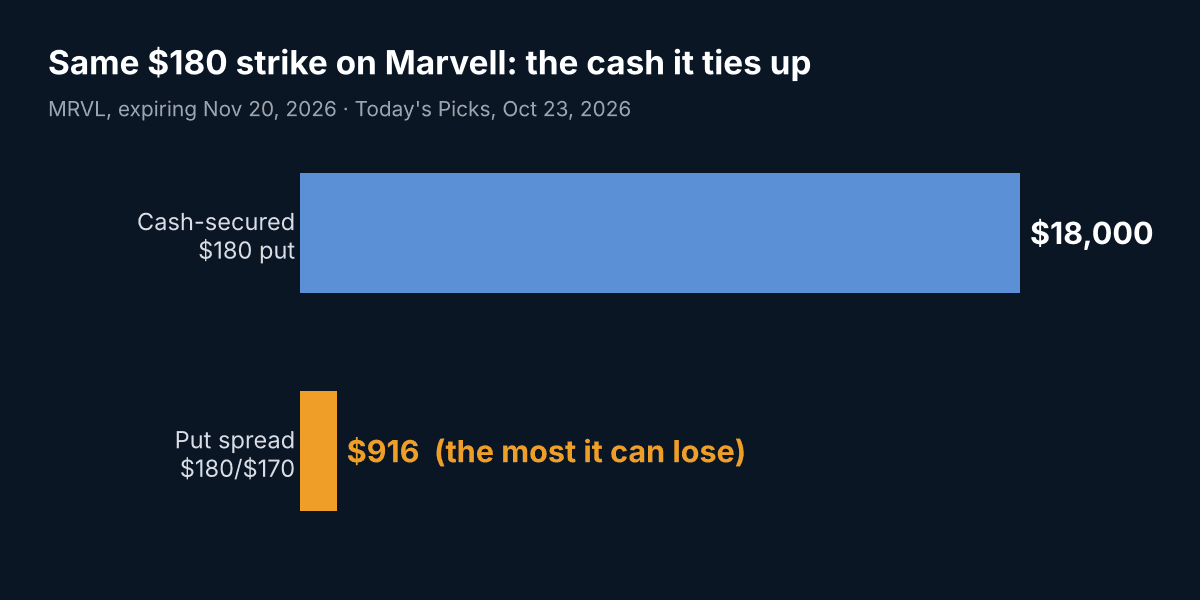
On Friday, Oct 23, 2026, one of the setups on SpreadVector’s Today’s Picks was a Marvell (MRVL) put spread, $180/$170, expiring Nov 20.
Sold as a cash-secured put, the $180 put alone would need $18,000 set aside for one contract. As a spread, it needed $916.
How a put spread works
A put spread is two puts on the same stock, with the same expiration:
- You sell a put at the higher strike. That’s where the premium comes from.
- You buy a put at a lower strike. It costs a little, and it’s your guardrail.
You collect more for the put you sell than you pay for the one you buy. The difference is your credit. If the stock falls far below both strikes, the put you bought covers everything below it. However far the stock falls, your loss stops there.
The four numbers, worked out
For the MRVL $180/$170 spread, with a $0.84 credit:
- Width: $180 − $170 = $10
- Most you can lose: $10 − $0.84 = $9.16 a share, or $916 per contract. That’s also the cash your broker holds.
- Breakeven: $180 − $0.84 = $179.16 at expiration
- Return on risk: $84 ÷ $916 = about 9.2% in 28 days
The free credit spread calculator works out these four numbers for any spread in a few seconds.
The catch: one loss against many wins
A spread caps your loss, but it also caps your premium, and the gap between the two is wide.
On the MRVL spread you collect $84 and can lose $916. One full loss takes about 11 wins of the same size to make back.
The same day’s picks had an Abbott (ABT) $92.5/$82.5 put spread, Nov 20, for a $0.28 credit: collect $28, risk $972. One full loss there takes about 35 wins to make back.
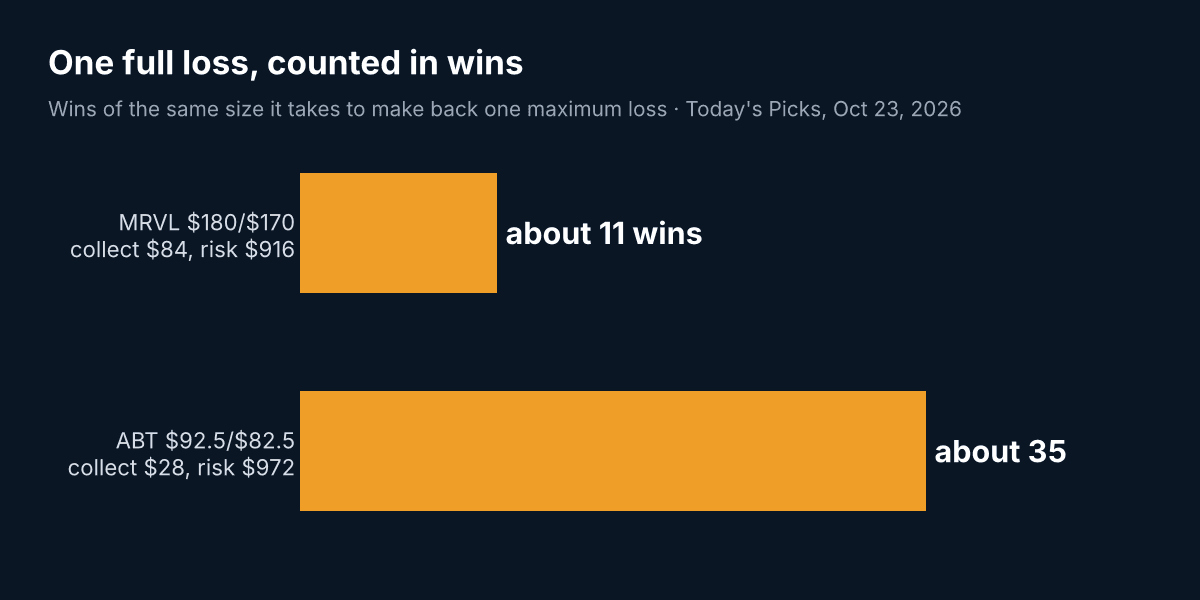
That’s why I put the short strike of a spread further from the stock than I might on a cash-secured put. Both of these were at 9-delta (what delta to sell puts at). And it’s why a spread should be, if anything, more careful than a put, not less. A spread that goes all the way against you doesn’t leave you with shares to sell covered calls on. It just closes at its maximum loss.
Which one, when
A put spread makes sense when:
- Your account is small. With under $10,000, one cash-secured put on many stocks is out of reach. A $10-wide spread ties up under $1,000.
- The stock is expensive. MRVL, ASML or SPY need tens of thousands per contract as cash-secured puts.
- You don’t want the shares. A spread’s worst case is a known number, not 100 shares.
- You want to spread risk across several names instead of tying up everything in one.
A cash-secured put makes sense when:
- You’d be happy to own the stock at that strike, and you have the cash.
- You want to run the wheel. Assignment is the start of the next step, not the end.
- You want one leg instead of two. One order, one bid/ask spread to pay.
I use both, and I run the same checks on both: around 10-delta, no earnings before expiration, outside the expected move, a liquid option. Then I look for confluence: the stock above its moving averages, a support area under the strike. Last Touch makes the final call, and I always read the news for something unforeseen. The structure changes. The checks don’t.
Both spreads passed the same checks
- No earnings before expiration: neither company reports before Nov 20 (why we skip earnings).
- Trend: ABT was above its 100- and 200-day moving averages; MRVL had been in an uptrend over the previous three months.
- Last Touch: ABT hadn’t closed at or below $92.50 in 71 trading days, MRVL not at or below $180 in 61 (what Last Touch means).
Examples only, not recommendations. Today’s Picks, Oct 23, 2026. Prices don’t include commissions.
SpreadVector’s Credit Spreads screener runs these checks on the short strike of every spread and shows the credit, the most you can lose and the return on risk on each result (see the plans, or try it free for 7 days).
Use it with the other checks
All the checks in one place: Before you sell a put: 5 checks every time, plus 1 of 2.
Quick answers
Is a put spread safer than a cash-secured put?
Its worst case is smaller and known in advance. But one full loss erases many wins, so it needs the same checks and a strike further from the stock.
How wide should the spread be?
Wider spreads collect more but can lose more. $5 and $10 widths are common. Size it by the most it can lose, not by the credit.
Can I be assigned on a put spread?
Yes, on the put you sold, usually only if it finishes in the money. The put you bought still protects you below its strike. Most traders close spreads before expiration to avoid it.
When do you close a spread?
I close when I've made 50% of the credit within the first couple of days or a week. Near expiration, a spread close to the short strike can swing to the full loss in an afternoon.
All 5 picks every weekday at 11:00 AM ET, each with its Last Touch and why it made the list, and every screener for 7 days.
- All 5 of Today's Picks, at live prices
- 4 screeners across 800+ stocks and ETFs: Short Puts, Credit Spreads, Earnings Drift and Dividends
- Set your own delta, expiration and minimum Last Touch (10 days to a year+)
- Courses and Command Center
SpreadVector is a screening and education tool, not investment advice. Options involve risk and aren't suitable for every investor. The Marvell and Abbott examples use Today's Picks prices from Oct 23, 2026, and don't include commissions.