- Every time: no earnings before expiration, a low delta (10 to 15), the strike outside the expected move, a tight bid/ask spread, and a long Last Touch.
- Then one of two: the stock in an uptrend, or the strike below a support zone.
- Requiring all seven at once leaves very little to trade, especially in earnings season.
Selling a put is a simple promise: you agree to buy 100 shares at the strike price, and you’re paid today for making it. The premium is the easy part to see. The hard part is everything the premium doesn’t tell you.
Here’s the routine we use before every put we sell, and the one behind every card in Today’s Picks. Five checks every time. Then one more reason the price should hold, from a choice of two.
The five we check every time
1. No earnings report before expiration
An earnings report is the one day a stock can move 10% or more overnight, in either direction, for reasons no chart can see coming. If the report lands before your put expires, you’re carrying that risk for the price of an ordinary week.
The premium usually looks better before earnings, and that’s the trap. The extra premium isn’t a gift. It’s the market charging for the gap.
So the rule is simple: if the company reports before expiration, we skip it, however good it looks. We pick a different stock, or an expiration that ends before the report.
2. A low delta: 10 to 15
Delta is often used as a rough estimate of the chance an option finishes in the money. A 10-delta put works out to roughly a 10% chance it ends in the money, or about 90% that it expires worthless. A 15-delta put works out to about 85%. It’s an estimate from today’s option prices, not a guarantee: stocks move, and the odds change with them.
We sell puts around 15-delta and put spreads around 10-delta. A 30-delta put pays more, because its strike is closer to the stock price. The trade-off: about a 70% estimate that it expires worthless, compared with about 90% for a 10-delta put.
3. The strike outside the expected move
Every option chain carries a number most traders never look at: the expected move. It’s the range the options market is pricing in for the stock by expiration, worked out from option prices themselves.
Say a stock is at $100 and the expected move to expiration is about $6. The market is pricing in roughly $94 to $106. A $95 strike sits inside that range: an ordinary move could reach it. A $92 strike sits outside: the stock needs a bigger-than-expected drop to get there.
We want the strike outside, below the low end of the range. It doesn’t make the trade safe. It means you’re not selling a put at a price the market already thinks is within reach.
4. A tight bid/ask spread
The bid/ask spread is the gap between what buyers pay and what sellers ask for the option. It’s a cost you pay going in, and again if you close early.
An option quoted at $1.40 / $1.50 is a 10-cent gap. You can get in near $1.45 and out at a fair price. One quoted at $1.00 / $1.60 is a 60-cent gap. You might sell at $1.10, and if you need to close, you could be paying $1.50 or more just to get out. On a $1.30 premium, that gap can be most of what you made.
We only use options where the gap is tight. Wide spreads don’t show up on your statement as a fee, but they cost you all the same.
5. Last Touch: how long since the stock was at the strike
Last Touch is the number of trading days since the stock last closed at or below your strike. A strike the stock hasn’t closed at in two years sits below a lot of past trading. One it touched last week doesn’t.
An example from Oct 9: Costco’s $870 strike hadn’t been touched in 200 trading days. Accenture’s $175 strike, further below its stock price in percentage terms, was touched just 9 trading days earlier. On paper, Accenture looked safer. The history said otherwise (more on Last Touch).
The expected move tells you what the market is pricing in. Last Touch tells you what actually happened. We want both on our side.
In my own trading, two checks I never bend on are earnings and the expected move. Last Touch is what pulls it all together for me. It’s the warm fuzzy that brings me over the finish line.
Then one of these two
Passing the first five means the trade is sound. These two add a reason the price should hold over the coming weeks. Either one is enough. Requiring both cuts the list to very little, especially in earnings season.
6. The trend: above the 100- and 200-day moving averages
A stock trading above both its 100-day and 200-day moving averages has buyers behind it over months, not just days. Selling a put on a stock in an uptrend means the drift is working for you, not against you.
It’s not a guarantee. Uptrends end. But a put sold into a long downtrend is fighting the current, and a put sold into an uptrend isn’t.
7. A support zone above the strike
A support zone is a price area where buyers have stepped in several times before. If your strike sits at or below that zone, the stock has to break through it before your strike is even in play.
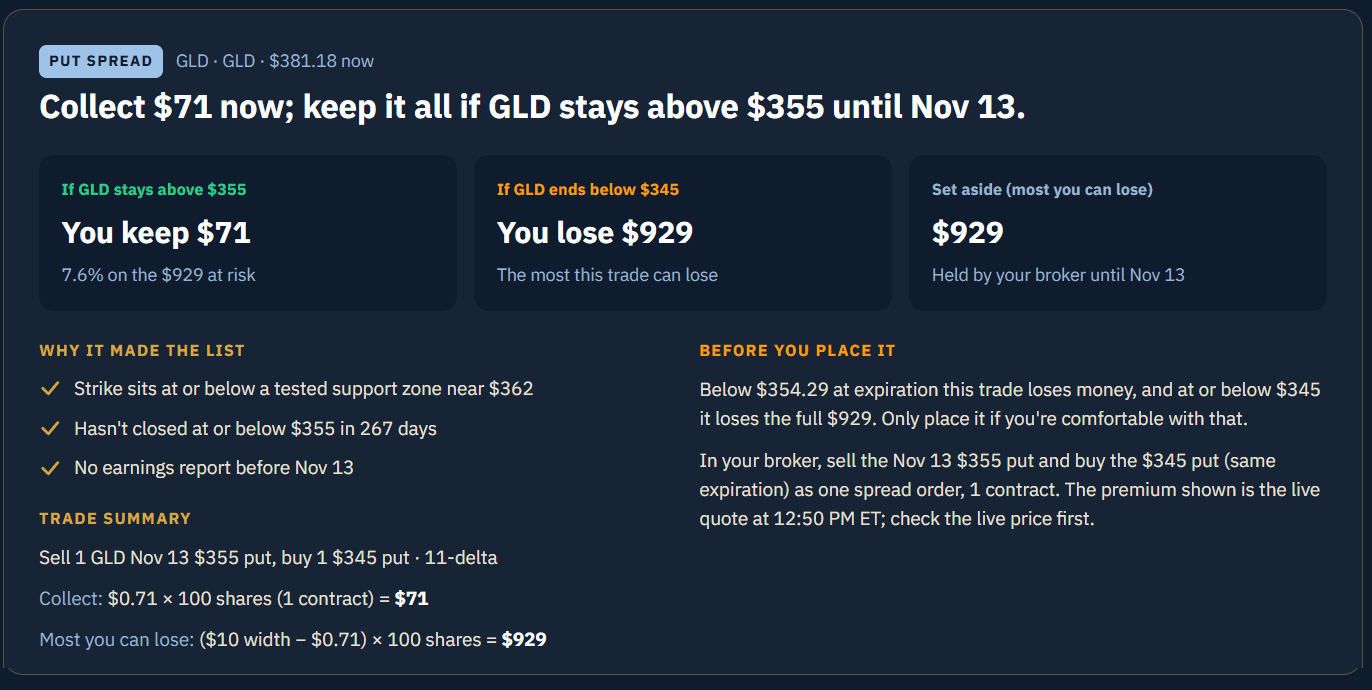
One of our Oct 13 picks shows it: a GLD put spread, with GLD at $381 and the upper strike at $355, below a tested support zone near $362. The stock would need to fall through that zone first. GLD also hadn’t closed at or below $355 in 267 trading days, so the support and the Last Touch point the same way.
The one minute we never skip
The numbers come back in seconds. Then we do the one thing no screener can: we read the news.
The checks tell you where a stock has been. A headline (a lawsuit, a downgrade, a deal) can change where it’s going. If something in the news makes you uneasy, skip it. There’s always another put.
SpreadVector runs the five must-haves on every setup and shows Last Touch, the trend and the support zone beside each one (try the full screeners free for 7 days).
Use it with the other checks
Quick answers
Do I need all seven checks to pass?
No. The first five every time, then the trend or a support zone. Requiring all seven leaves very few trades, especially during earnings season.
What if a stock passes everything but the premium is small?
Then it's a small premium on a sound trade. Chasing bigger premiums usually means giving up one of the first five checks.
Do these checks guarantee the put expires worthless?
No. They keep you out of the most avoidable mistakes. Any stock can fall through any strike.
Where do I find the expected move?
Many brokers show it on the option chain. SpreadVector shows it on every Short Puts and Credit Spreads result, in the Expected Move box, and checks it on every setup.
All 5 picks every weekday at 11:00 AM ET, each with its Last Touch and why it made the list, and every screener for 7 days.
- All 5 of Today's Picks, at live prices
- 4 screeners across 800+ stocks and ETFs: Short Puts, Credit Spreads, Earnings Drift and Dividends
- Set your own delta, expiration and minimum Last Touch (10 days to a year+)
- Courses and Command Center
SpreadVector is a screening and education tool, not investment advice. Options involve risk and aren't suitable for every investor. Examples use closing prices from Oct 9, 2026 and a live quote from Oct 13, 2026, and don't include commissions.